A merchant's house of 1731, kept as a shell and relined
Six metres and twenty across the front, four floors behind it, and a souterrain that was the wool store when the harbour outside was still working.
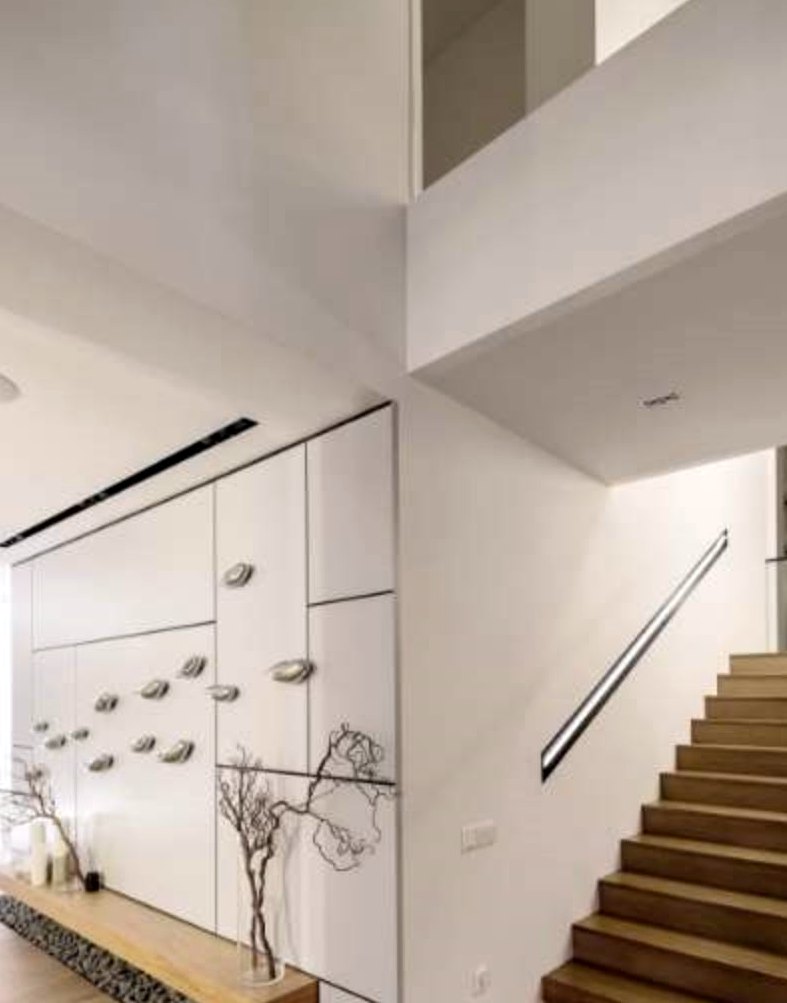
What was taken out, and what was not allowed to be
The house was a warehouse, then flats, then empty for nine years. In 2016 everything that had been added to it since 1900 came out.
The frame is oak, the floors are pine on oak joists, and the front is brick with a sandstone band at first-floor level. The gable is a neck gable, rebuilt in 1884 after a fire two doors along, which is why it does not match its neighbours and why nobody has ever tried to make it.
What came out: eight partition walls, two bathrooms stacked in the stairwell, a lift shaft that had been started and abandoned, and the suspended ceilings that had been put in when the floors were offices. What was not allowed out: the stair, the front, the beams, and the souterrain vault, which is listed and would not have come out anyway.
The house in detailEight rooms, and no two of them the same shape
A house this narrow does not produce repeatable rooms. Each floor has its own ceiling height and its own window line.
The first floor, the old beletage, has the tallest windows and two rooms. The second has three, the third has two under lower ceilings, and the attic is not let: it holds the hoist beam, the water tank and a great deal of nothing.
Floor by floorThe casino room is the souterrain, under the front of the house
Not a neighbour, not another address, and nobody steps outside to reach it.
The casino floor holds three tables and a counter, and it opens on four evenings a week. Until about 1860 this was the wool store: the harbour outside took the bales off the barges, a hatch in the quay wall dropped them in, and the merchant's clerk counted them at a desk in the corner. The hatch is bricked up and visible, and the brick is a different colour, which is the sort of thing that cannot be faked.
From the desk in the hall you walk behind it, take the stair, and go down six steps: twenty-five paces, none of them outdoors. One of the staff holds that door through every hour it is open, and the rule at it is 18 with photographic proof, on every visit.
What the souterrain is likeThe quay outside has not been a working harbour since 1963
It is now where people keep old boats, which is quieter and better looking.
The Grote Kerk is six minutes east on foot. The Merwede is directly south across the water, and it is the busiest inland shipping junction in Europe, which you notice at night.
The quay and the town